10 Months
UX Lead then Senior UX Design Manager.
Drug R&D Microbiologist
SaaS
2 Product Owners
1 Development Manager
20 Developers
5 Data Scienctist & AI Devs
1 UX Design Lead
1 Visual Designer
1 UX Researcher
Watson for Drug Discovery was redesigned to turn search from basic retrieval into a discovery engine capable of surfacing gene–disease relationships hidden across 100+ million articles. By aligning search with how scientists form hypotheses — using guided facets, transparent evidence, and iterative exploration — we enabled breakthroughs like identifying novel ALS-related genes and cut discovery timelines from months or years to weeks.

Before: Before: The Entity Explorer experience forced users to set complex filters, remember results across many sets of prioritized entities,and guess at the names of entities from 5 letters presented to the user.

Before: Individual article views were poorly structured — with hidden labels, inaccessible color choices, and no controls to filter out irrelevant information — making it hard for researchers to extract meaningful insights from the evidence.
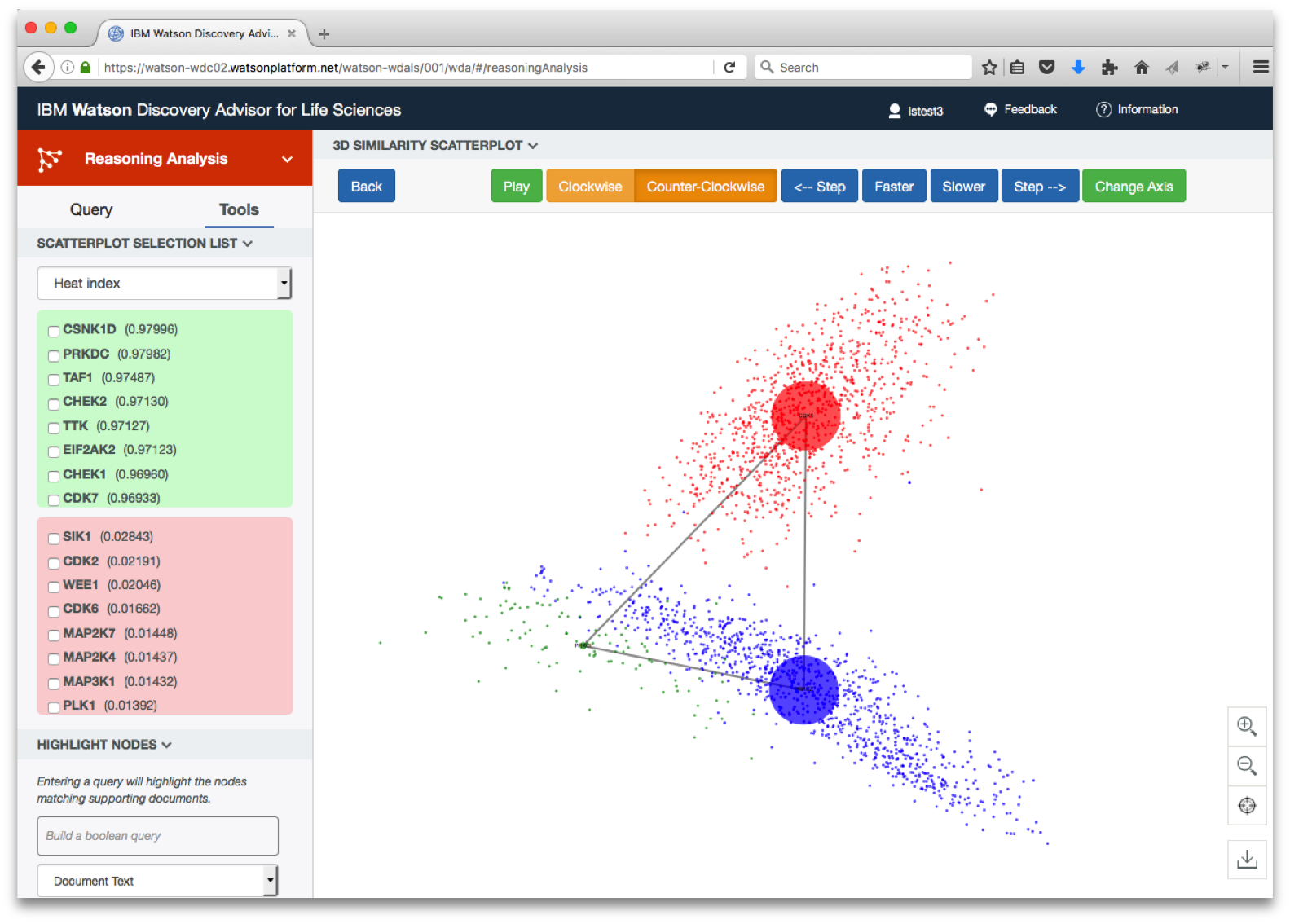
Before: The evidence visualization relied on an auto-spinning 3D model with tiny, nearly unclickable targets, creating more distraction than insight and preventing researchers from meaningfully exploring relationships between entities.
When I joined the WDD team, IBM had spent nearly two years building an AI-powered search platform intended to mine over 100 million scientific articles for drug discovery insights — but without any design input or user feedback.
Researchers described the tool as unusable: they couldn’t trust results, interpret visualizations, or understand how the system reached conclusions. Instead of accelerating discovery, the system slowed it down. Usability testing confirmed the problem: the platform failed to support how scientists search, think, and build hypotheses.
We embedded ourselves in the daily workflows of scientists at Baylor, MD Anderson, Teva, and Harvard, conducting interviews, lab observations, and usability studies
Key insights reframed the entire product strategy:
These insights transformed our design challenge: turn search from a retrieval feature into a discovery engine.

User Research: We completed product testing, user observation and interviews to better understand the domain and microbiologist in universities and industry.

Synthesizing Data:The data from these interviews, observations and product testing was synthesized and organized to form a user’s mental model.
We convened a two-day design thinking workshop with data scientists, engineers, and PMs to realign the team around these new insights. Together we defined core user outcomes and design principles that guided every decision:
This alignment laid the foundation for a radically new search experience.
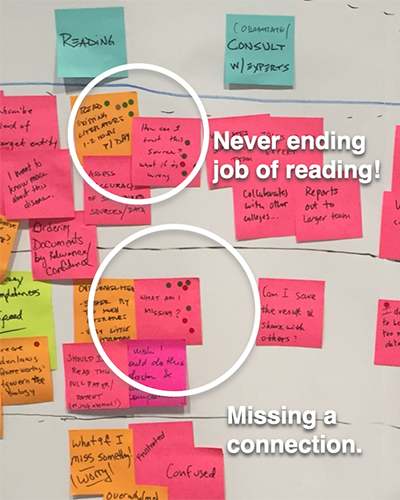
Empathy Maps: During the workshop the teams identified and aligned to the users biggest pain points.

Radical Collaboration: The team came together to define the product release by building empathy for the user and reflecting it on empathy maps, and journey maps. Finally we ideated lots of solutions to solve pain points.
We rebuilt WDD’s search experience around the way scientists think and work:
This design put scientists back in control, reducing the friction between AI output and scientific reasoning.

As-Is Storyboard: Researchers face relentless pressure to manually sift through endless reports and articles, slowing discovery and increasing cognitive load.

As-Is Storyboard: Current workflows consume weeks compiling and prioritizing findings — time that could be spent advancing research.

To-Be Storyboard: The redesigned experience consolidates all of Watson’s evidence in a single, searchable view, connecting data and relationships in one place.
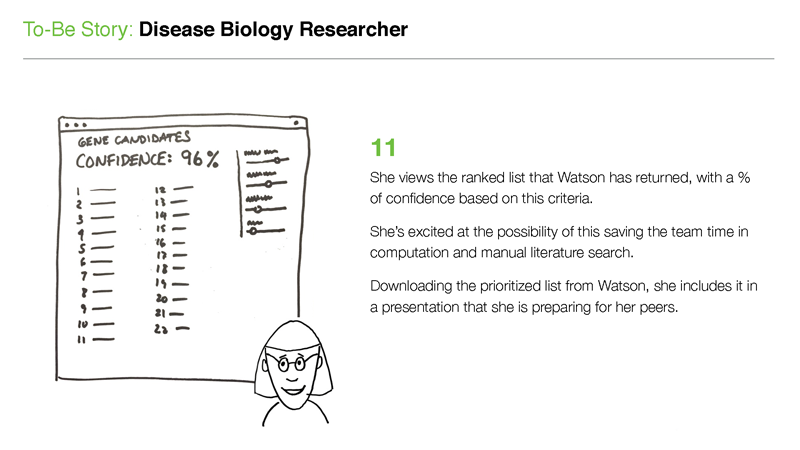
To-Be Storyboard: By surfacing prioritized candidates instantly, the new workflow dramatically reduces research time and accelerates the path from evidence to experiment.
The results were transformative:
“Watson didn’t just speed up our work — it gave us a way to find things we didn’t even know to look for.” – Baylor scientist feedback

Sketch: Early concepts focused on giving researchers a single, comprehensive view of an entity and its relationships — transforming a complex, abstract challenge into a tangible design conversation.
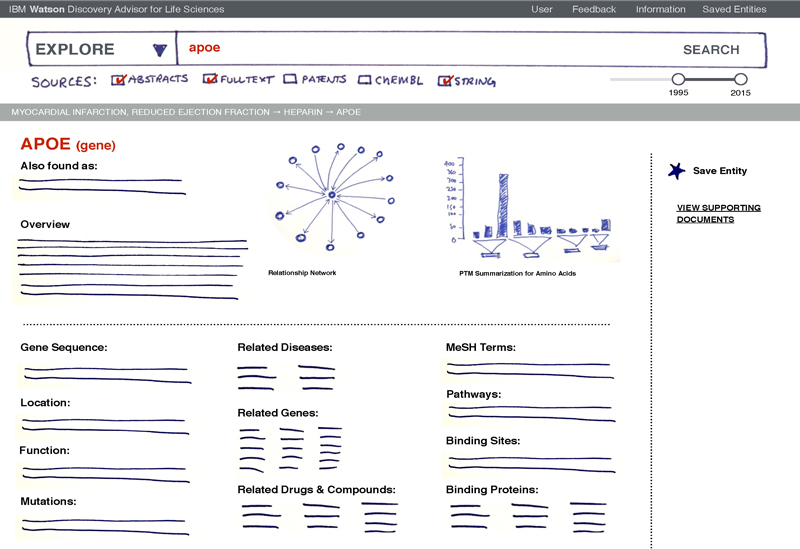
Sketch: We explored ways to simplify the relationship network, including moving advanced options into a dedicated settings drawer to reduce visual complexity and support focused exploration.
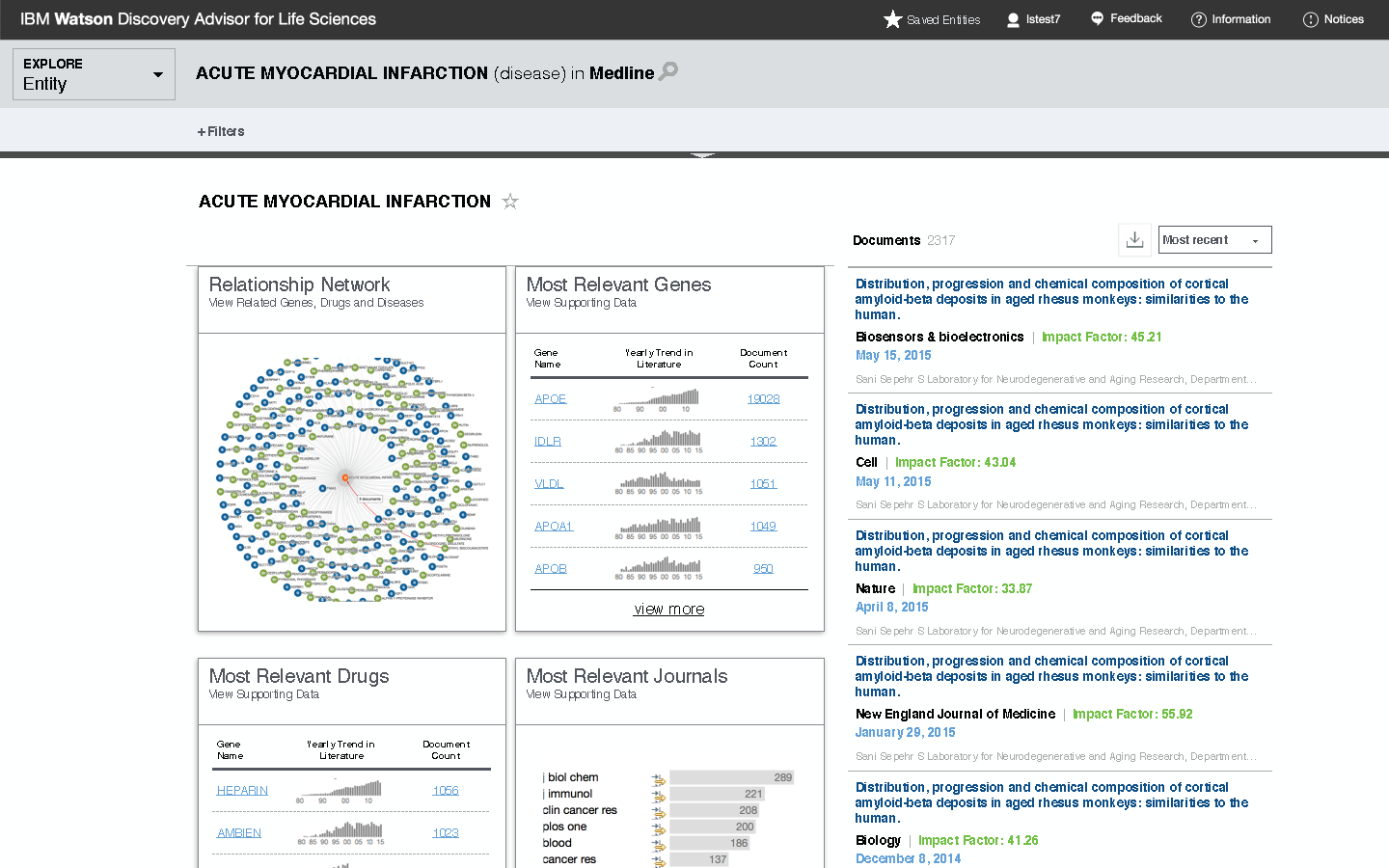
Wireframe: As fidelity increased, we designed deeper drill-downs that linked organized information directly to the underlying literature, giving researchers traceable evidence for every connection.

Wireframe: We incorporated accessible color choices and new filtering controls.

Wireframe: Expanded network views revealed how entities were connected.
This project redefined search as a strategic capability — not just a way to retrieve data, but a way to surface connections, form hypotheses, and accelerate discovery. By aligning AI-powered search with human cognitive models, we turned Watson into a thinking partner for scientists — proving that when search is designed as a discovery tool, it can fundamentally change the trajectory of drug development.

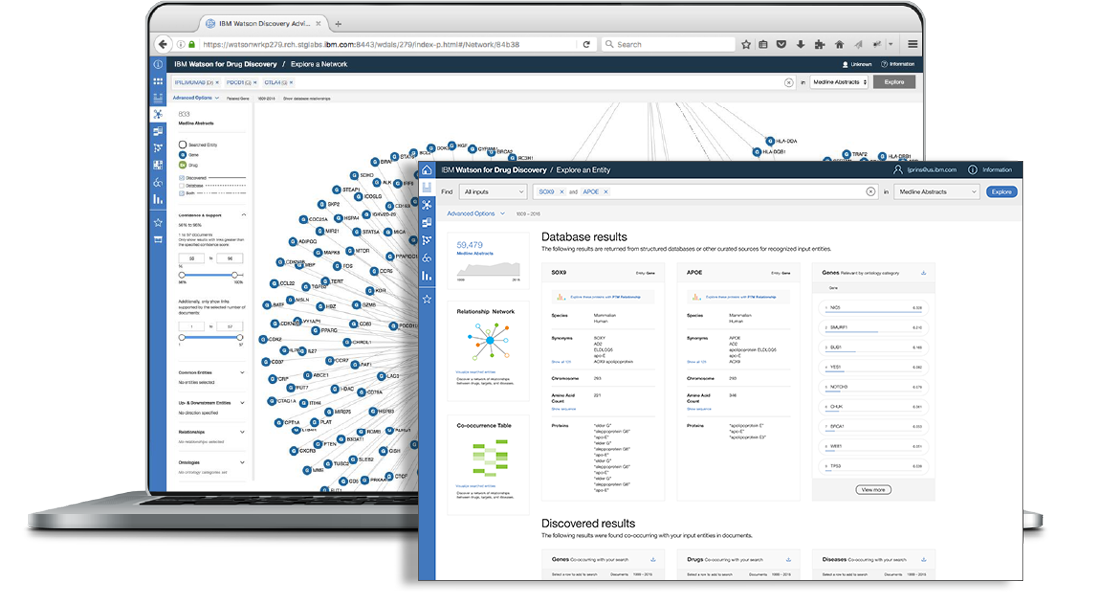
Production Software: Giving the micro-biologist a single place to see everything meant surfacing data from many systems.

Production Software: The improvements to the Explore Network included placing less frequent options in an advanced menu and improving the controls on the network diagram.